
Intent:
At St Joseph and St Theresa, we value Art and Design as an important part of the children’s entitlement to a broad and balanced curriculum. We believe that Art provides all children with the chance to develop and extend their skills by expressing their own individual needs, thoughts and ideas. We facilitate the opportunity for students to draw, paint and sculpt as well as learn about specific styles of art and artists.
Children will be inspired to express themselves while letting their curiosity transport them to another world. Through lessons, children will develop skills confidently and creatively whilst using different mediums. Through high-quality art lessons, children will be encouraged to think innovatively and develop creative procedural understanding. The skills they acquire are applied to their cross-curricular topics allowing children to use their art skills to reflect on and explore topics in greater depth.
In art, children will be expected to be reflective and evaluate their work, thinking about how they can make changes and keep improving (just like real artists); this should be meaningful and continuous throughout the process. Children are encouraged to take risks and experiment whilst reflecting on the steps they have taken in order for their techniques to be successful.
Within our art curriculum, we intend to cater to the needs of all children, including those with SEND by allowing for quality-first teaching, differentiation and adult support.
At St Joseph and St Theresa, we value Art and Design as an important part of pupils’ entitlement to a broad and balanced curriculum. We believe that Art and Design provides pupils with the chance to develop and extend their skills by expressing their own individual needs, thoughts and ideas. We facilitate the opportunity for them to draw, paint and sculpt.
Pupils will be inspired to express themselves while letting their curiosity transport them to another world. Through high-quality lessons, they will develop skills confidently and creatively whilst using different mediums. Pupils will be encouraged to think innovatively and develop creative procedural understanding. The skills they acquire are applied to their cross-curricular topics allowing pupils to use their art skills to reflect on and explore topics in greater depth.
In Art, pupils are expected to be reflective and evaluate their work, thinking about how they can make changes and keep improving (just like real artists). This should be meaningful and continuous throughout the process. Pupils are encouraged to take risks and experiment whilst reflecting on the steps they have taken in order for their techniques to be successful.
Implementation
At St Joseph and St Theresa, the curriculum is carefully mapped out to ensure that pupils acquire knowledge, vocabulary and skills in a well-thought out and progressive manner in every curriculum subject, ensuring sufficient coverage across each subject over time. New learning is based upon what has been taught before and prepares pupils for what they will learn next. There are clear end points which pupils work towards on their learning journey.
Children are taught art as part of our ‘Curriculum Journey’ lessons which link to their Curriculum topic allowing a fully immersive learning experience. Art is taught weekly for the first half of each term, with DT being taught the other half. Each term, the children will complete an art project, based on an artist or style of art linked to their curriculum topic with planning supported by the Chris Quigley scheme of learning. Chris Quigley’s planning follows an ethos of ‘revisit, revisit, remember’ across basic, advance and deep levels of learning, allowing information to be embedded into children’s long-term memory. Children will receive a research based lesson to begin the topic, a design/planning lesson, short skills sessions, a ‘make’ lesson and then a ‘reflect and review’ lesson. The topics carried out allow children to explore both traditional and more modern pieces of work. The work of famous local, national and international artists are explored to enhance the children’s learning and allow them to study and relate their work to that of people who are known for their impact on the creative arts and cultures.
The teaching of the art curriculum is based on the National Curriculum to ensure a well-structured approach to this creative subject, it provides a broad framework and outlines the knowledge and skills taught in each Key Stage. The ‘Progression of Knowledge & Skills’ document ensures all strands of the curriculum are covered and the skills/knowledge taught is progressive from year group to year group. Teachers plan lessons using the progression document as well as the Chris Quigley scheme of learning, ensuring they are suitable to their class’s interests. Each lesson follows a 6-part structure in line with the rest of our curriculum to ensure consistency across the school.
Teachers are provided with planning time to construct their knowledge organisers (including vocabulary) that all children must be able to access. These take on a holistic role as they contribute to all of the other subjects in our school day i.e. Maths, English, Science, Geography, History, Music, PE etc. When teaching art and design, teachers should follow the children’s interests to ensure their learning is engaging, broad and balanced. A variety of teaching approaches are used based on the teacher’s judgement.
Teachers demonstrate how to produce good-quality artwork but encourage children to be free in their creativeness in order to form their own ideas. Teachers find opportunities where possible to link the outdoor learning and bring the outdoors back into the classroom in order to provide children with a wide-range of opportunities for learning.
Art work is evidenced through an individual sketch book, in which skills based sessions are recorded as well as pictures/evidence of the finished product, these along with other evidence will then be scrutinised on a termly basis by the Art lead through pair share meetings with the children. Children engage in both longer art and design lessons in which they plan and create as well as shorter skills based sessions, where they are able to focus on a particular skill linked to an artist or style of art that they are focussing on. The repetition of the shorter sessions allows for children to become fluent in the common skills across the curriculum which can then be mastered and applied in their longer ‘create’ based curriculum journey art lessons.
At St Joseph and St Theresa, the curriculum is carefully designed to ensure that pupils acquire knowledge, vocabulary and skills in a well-thought out and progressive manner ensuring sufficient coverage across each subject over time. New learning is based upon previous learning, which prepares pupils for what they will learn next. There are clear end points in each year group which pupils work towards on their learning journey; these are set out in the progressions grid.
Art is taught as part of our ‘Fascinating Friday’ days and all activities link to the topic being taught. Different artists are linked to these topics, which allows pupils to explore both traditional and more modern styles. The work of famous local, national and international artists are explored to enhance the pupils’ learning and allows them to relate their work to people closer or further afield.
The teaching of the Art curriculum is based on the objectives set out in the National Curriculum to ensure a well-structured approach to this creative subject and provides a broad framework which outlines the knowledge and skills taught in each Key Stage. Teachers plan lessons for their class using our progression of knowledge and skills document. Teachers can use this document to plan their art and design lessons suitable to their classes interests and what they want them to learn. The progression document ensures the curriculum is vastly covered and the skills/knowledge taught is progressive from year group to year group.
Teachers are provided with planning time as a team to construct their knowledge organisers that all pupils must be able to access with a focus on the art vocabulary children should be exposed to. These take on a holistic role as they contribute to all of our other subjects in our school day i.e. maths, English, science, geography, history, music, PE etc. When teaching art and design, teachers should follow their pupils’ interests to ensure their learning is engaging, broad and balanced. A variety of teaching approaches are used based on the teacher’s judgement.
Teachers demonstrate how to produce good-quality artwork but encourage pupils to be free in their creativeness in order to promote their own ideas. Teachers find opportunities to link outdoor learning and bring the outdoors back into the classroom in order to provide pupils with a wide-range of opportunities for learning.
Impact
Pupils at St Joseph and St Theresa are able to become creative learners, who have a web of knowledge about the fantastic artists of the world. Creativity is celebrated and children become attentive and intentional at editing and improving the pieces they have created. As teachers, there will be an emphasis placed on curiosity and individuality to explore art using their own freedom and imagination. However, teachers demonstrate and share examples to children so they are able to develop knowledge of skills. All children, including vulnerable learners will have embedded the key Art and Design skills needed to allow them to produce inventive pieces of art.
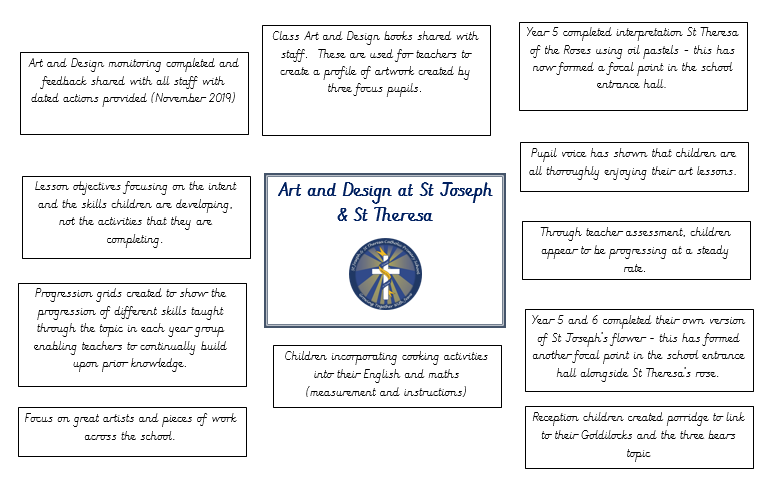
Within Art and Design, we strive to instil an appreciation and enjoyment of the arts, enriching children’s learning experience. Our curriculum is high quality, well thought out and is planned to demonstrate progression. We focus on progression of knowledge and skills and discreet vocabulary progression also forms part of the curriculum. Children will reach age related expectations in Art at the end of their cohort year and these will be built on every year so that children can develop and broaden their skills year on year. Disadvantaged learners and learners with SEND acquire the knowledge and skills they need to succeed in life and will achieve the best possible outcomes. This is assessed through termly Art work scrutiny, in which feedback regarding the teaching, recording and assessment of Art teaching will be provided for staff. Pupil voice is carried out through weekly pupil voice meetings in order to gain an understanding of the children’s Art understanding and level of enjoyment. Learning walks allow the subject coordinator to observe how Art is taught across school and pupils engagement and progress within Art lessons.
SEND Toolkit for Art and DT
